Ingredients
Method
- Keep everything measured and ready before the pan goes on — once the besan starts roasting, it needs your full attention and both hands. Sieve the gram flour if it is lumpy, and have the melted ghee warm beside the stove.
- Heat a heavy, wide kadai or pan on low heat. Add the besan and dry-roast it, stirring continuously and scraping the base, for 5 to 6 minutes. At this stage it simply warms through and loses its raw edge; do not expect colour yet.
- Pour in the melted ghee and mix it through the flour. Continue roasting on low heat, stirring without stopping in a steady figure-of-eight, for 22 to 28 minutes. The mixture will pass through stages: first dry and sandy, then clumping, then loose and flowing like wet sand as the ghee releases, and finally fragrant and deep golden. It is ready when the colour is a rich golden brown, it pours almost like thick batter, and the nutty aroma is unmistakable. This is the step the whole recipe stands on — under-roasted besan will taste raw in the finished ladoos no matter what you do later.
- If using melon seeds, stir them in for the last 2 minutes of roasting so they toast lightly in the hot mixture.
- Take the pan off the heat and tip the mixture into a wide plate or thali, spreading it out to help it cool. Leave it for 25 to 30 minutes, stirring once or twice, until it is just warm to the touch — you should be able to hold your palm against it comfortably. The mixture must not be hot when the sugar goes in.
- Add the powdered sugar and cardamom powder (and the chopped nuts, if using) and mix thoroughly with your hands or a spoon until the sugar is evenly worked through. The mixture should hold together when squeezed in your fist. If it feels too dry to bind, work in a teaspoon of warm melted ghee; if too soft, rest it 10 minutes longer.
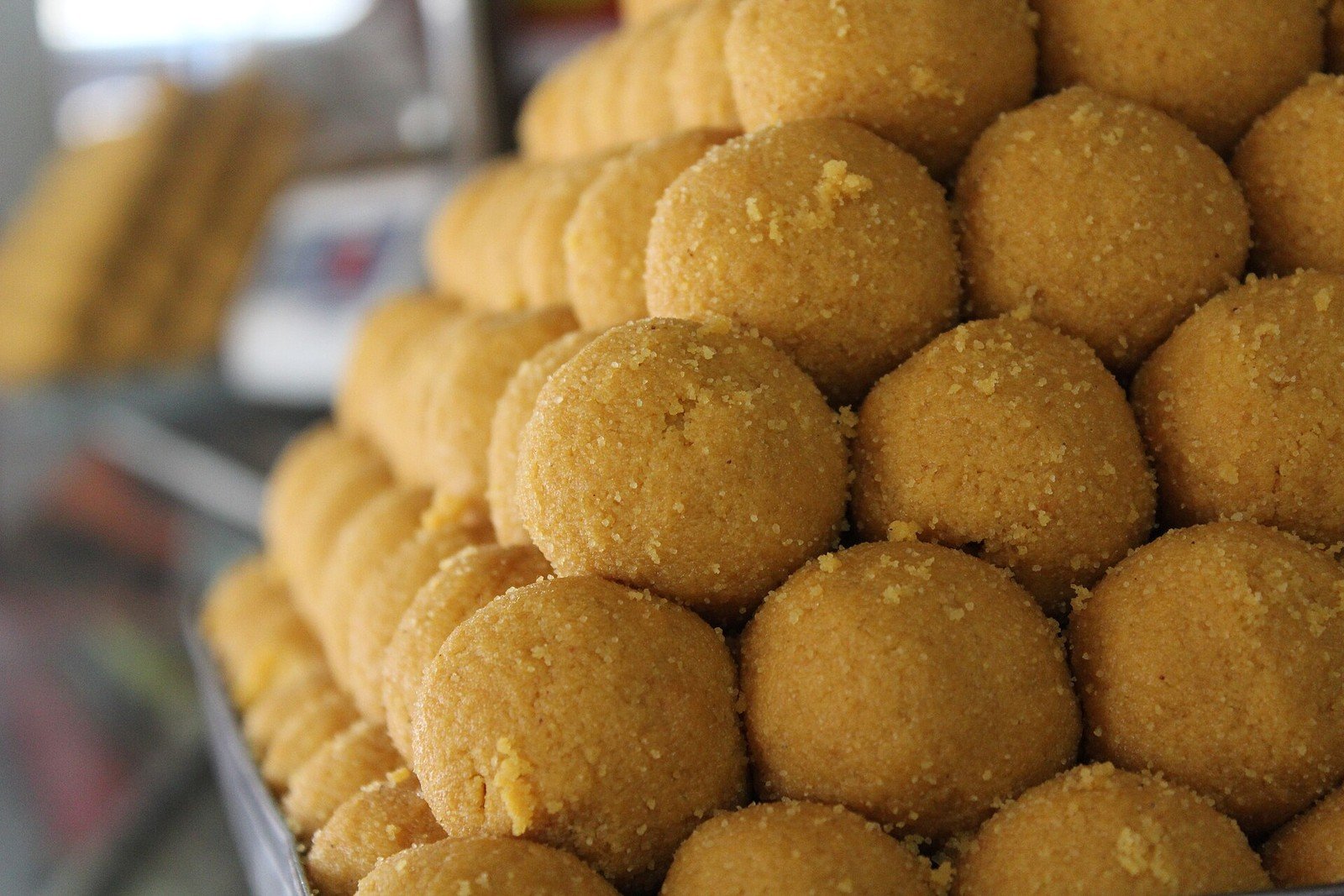
- Grease your palms lightly with ghee. Take portions of the mixture and roll them firmly between your palms into smooth, tight balls about the size of a small lime — you should get about 12. Work quickly while the mixture is still slightly warm; it turns crumbly as it cools. Set the ladoos on a plate and leave them for 1 to 2 hours to firm up completely before serving or storing.
Notes
Warm, never hot, for the sugar. This is the most common besan ladoo failure: sugar added to a hot mixture melts, and the ladoos stay soft and greasy and refuse to hold their shape. If you have added sugar too early by mistake, chill the mixture for 20 minutes and then shape — the flavour survives even if the texture is a little softer.
Boora (tagar) is the traditional sugar for a reason. Its coarse, dry crystals give besan ladoos their characteristic slightly grainy bite and absorb moisture better than fine icing sugar. Ordinary powdered sugar works fine; just make sure it is completely dry and lump-free.
Judge the roast by smell and flow, not by the clock. Pan thickness and flame size change everything. The reliable signs are the deep golden colour, the mixture moving almost like lava when stirred, and a roasted, nutty smell with no trace of rawness.
Storage is this sweet's great virtue: besan ladoos keep for 3 to 4 weeks in an airtight tin at room temperature, with no refrigeration. In fact, many families find the flavour settles and improves after the first two or three days.