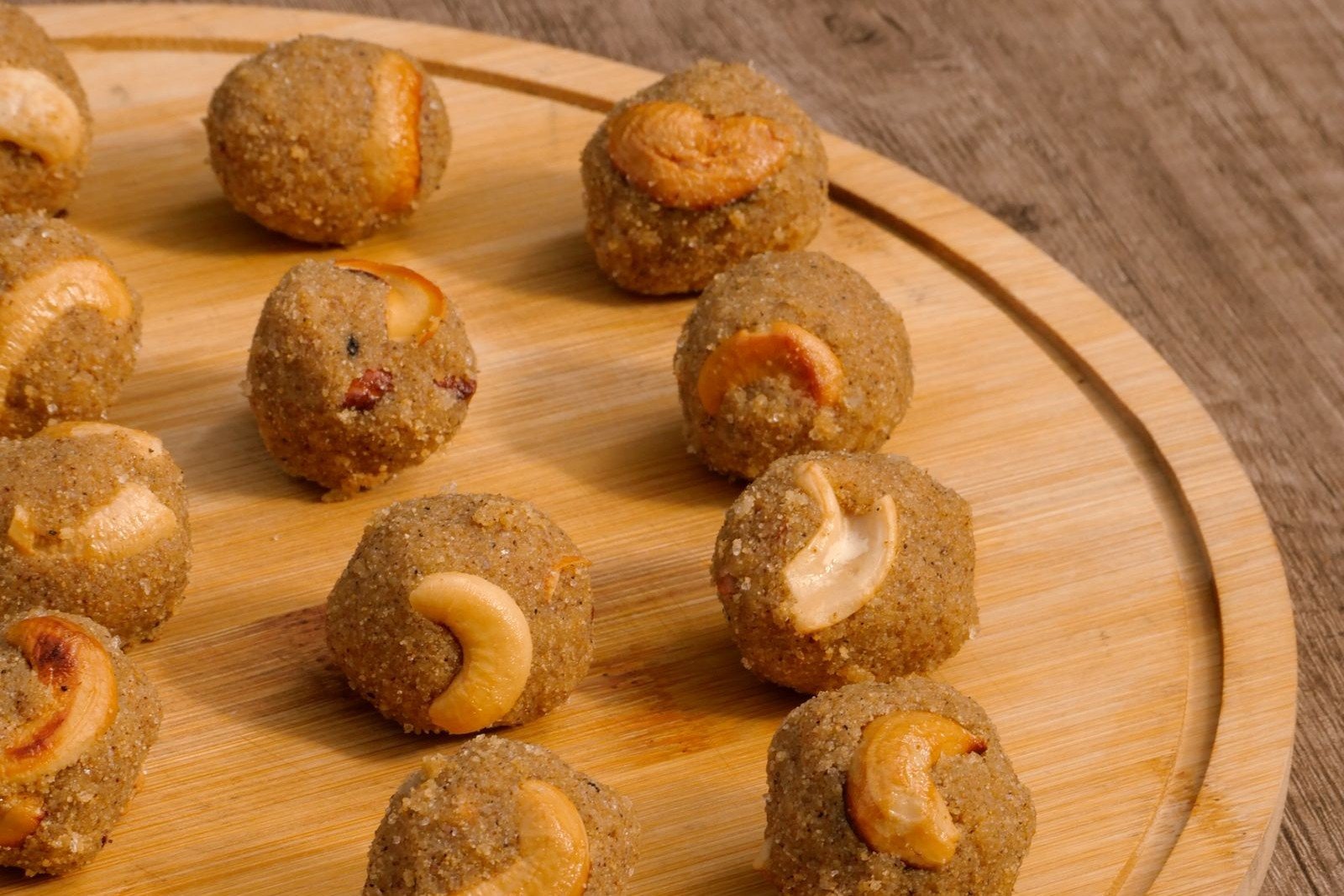
Rava ladoo is the sweet of busy festival kitchens: no syrup to judge, no khoya to reduce, nothing that can go badly wrong — just semolina roasted slowly in ghee until it smells like toasted nuts, sugar and cardamom stirred through, and warm, fragrant balls rolled while the mixture is still pliable. It is often the first mithai a new cook is trusted with, and it stays a favourite long after she has mastered harder things, because the pleasure is in the texture as much as the taste — fine, sandy and crumbly at the first bite, then melting into ghee and sweetness. A fried cashew or a plump raisin pressed on top, and it is ready for the puja plate, the sweet box and the journey to a relative’s house.
Ingredients
Method
- Prepare the sugar first: grind it fine while the pan is still cold, and set it aside in a wide mixing bowl. Ladoos made with gritty, half-ground sugar feel coarse on the tongue no matter how well the rava is roasted, so this step is worth the extra minute.
- Melt the ghee in a wide, heavy pan on low heat. Add the cashews and fry, stirring, until they turn a light golden colour, then lift them out with a slotted spoon onto a small plate. Drop the raisins into the same ghee and fry just until they puff up and swell; lift those out too, leaving the flavoured ghee in the pan.
- Tip the rava into the ghee and roast on low heat for 10 to 12 minutes, stirring almost without stopping and scraping the base of the pan. The rava is ready when it has deepened slightly in colour, feels lighter and looser under the spoon, and — the real test — smells warmly nutty and toasted rather than raw and floury. Do not rush it on higher heat: rava browns at the edges while staying raw in the middle, and that rawness will sit in the finished ladoos.
- Take the pan off the heat and tip the hot rava straight into the bowl of powdered sugar. Add the cardamom, the nutmeg if using, and the fried cashews and raisins. Mix everything thoroughly with a spoon while the rava is still hot, so the sugar coats every grain evenly.
- Leave the mixture for 3 to 4 minutes, until it is cool enough to handle but still decidedly warm. Sprinkle over 1 tablespoon of the warm milk and mix again — the mixture should now clump and hold together when you squeeze a fistful. Add the second spoonful of milk only if it still crumbles apart; too much milk makes dense, hard ladoos.
- Shape at once, while the mixture is warm: take roughly 2 tablespoons at a time, press it firmly together in your fist to compact it, then roll it between your palms into a smooth, round ball about the size of a large lime. Set each finished ladoo on a plate and press a fried cashew or a raisin or two into the top.
- Leave the ladoos uncovered at room temperature for about 30 minutes to firm up before moving them into a box — they are fragile while warm and set into neat, sturdy balls as the ghee cools and solidifies.
Notes
The roast is the recipe. Under-roasted rava tastes pasty and sticks to the roof of the mouth; properly roasted rava gives ladoos that are crumbly, fragrant and keep well. Judge by smell and colour, not by the clock alone.
Powder the sugar properly, and mix it into the rava off the heat — sugar stirred into a pan still on the flame can melt unevenly and make the ladoos chewy in patches.
Milk is only a binding helper here, used by the spoonful. Ladoos made with more milk must go into the fridge and be eaten within 2 to 3 days; with just a sprinkling, they keep well in an airtight box at room temperature for about a week.
If the mixture cools before you finish shaping and starts to crumble, warm it very briefly — a few seconds back in the warm pan, or a fresh sprinkle of warm milk worked through will bring it back.