Ada pradhaman is the payasam Kerala holds above all others — the one without which no sadya feels finished, no matter how many other sweets crowd the banana leaf. Its pleasures are deep and unhurried ones: soft, silky ribbons of rice ada, jaggery cooked down to a dark caramel sweetness, and coconut milk added in stages so the finished payasam tastes layered rather than simply sweet. It asks for patience more than skill — the ada must be soaked until it yields, the jaggery must simmer until its raw edge melts away, and the thick coconut milk must never be allowed to boil — but the reward is a payasam the colour of burnished copper, with fried coconut and cashews crackling on top, that tastes unmistakably of celebration.
Ingredients
Method
- Soak the ada first, because this is what makes it silky instead of chewy: tip the flakes into a bowl, pour over enough hot water to cover generously, and leave for 30 minutes. Drain, rinse two or three times in fresh water — this washes away the starchy film that makes ada clump — and drain again well.
- Cook the ada in the thin coconut milk: bring the 2 cups of thin coconut milk to a gentle simmer in a heavy pan or uruli, add the drained ada, and cook on medium-low heat for 10 to 12 minutes, stirring now and then, until the flakes are completely soft, translucent and swollen, with no firm white core when you press one between your fingers. Every piece must be fully cooked at this stage, because it will not soften further once the jaggery goes in.
- While the ada cooks, melt the jaggery in a small pan with 1/4 cup of water, just until it dissolves. Strain the syrup through a fine sieve to catch the grit and fibre jaggery almost always carries, and set it aside.
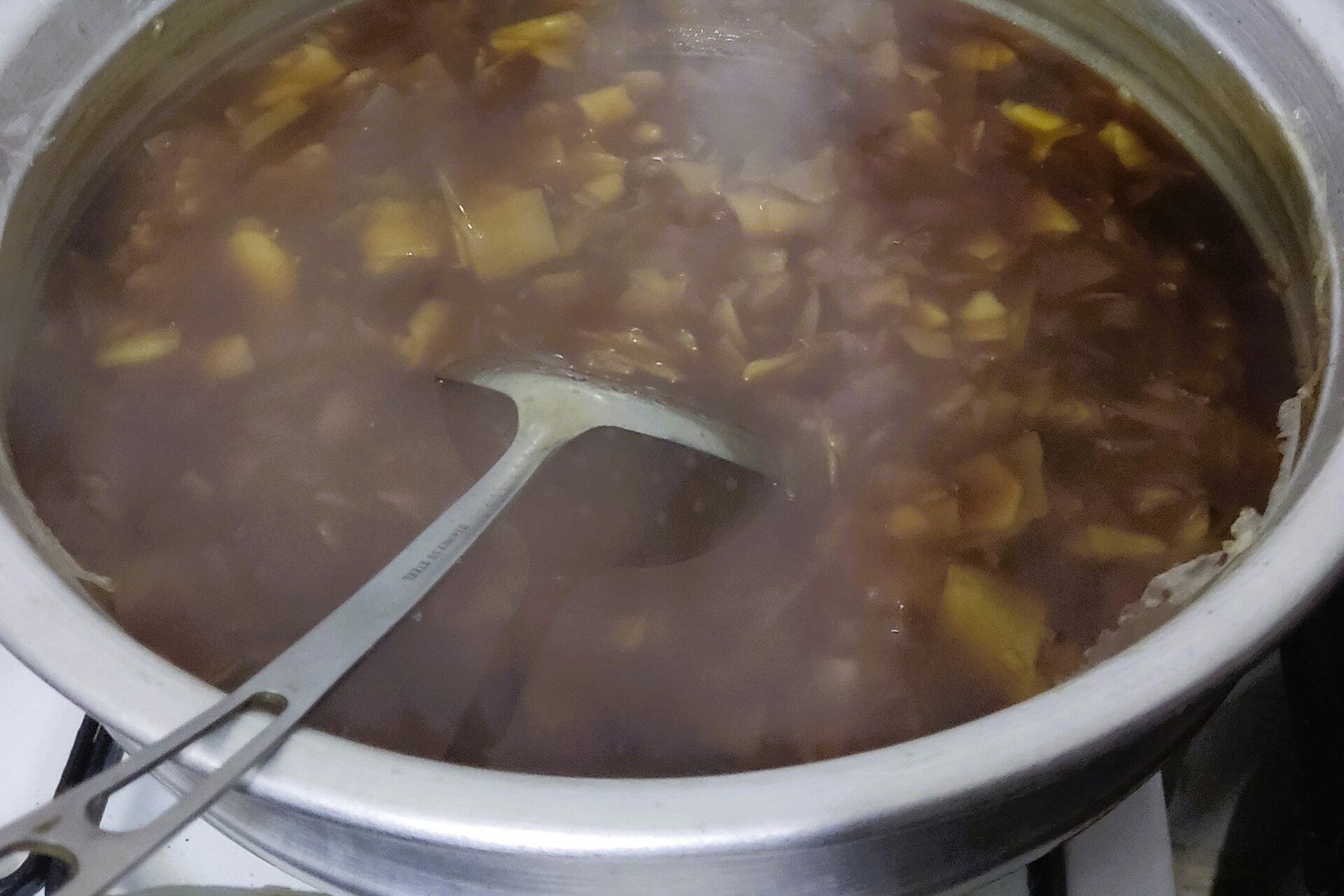
- Pour the strained jaggery syrup into the cooked ada and stir well. Simmer on medium-low heat for 8 to 10 minutes, stirring often, until the payasam turns glossy, deepens to a rich caramel brown and thickens enough to coat the back of a ladle. This simmer is the heart of the dish — it is where the raw, mineral sharpness of the jaggery mellows into the ada.
- Lower the heat to the minimum and stir in the thick coconut milk. Warm everything through for 2 to 3 minutes, stirring gently, until the payasam is steaming and unified — but do not let it boil from this point on. Boiling thick coconut milk can split it and turn the whole payasam grainy.
- Take the pan off the heat and stir in the cardamom, the dry ginger powder and the pinch of salt. Rest the payasam for at least 5 minutes — it will thicken slightly as it stands and the flavours will settle into each other.
- For the garnish, heat the ghee (or coconut oil) in a small pan, fry the coconut pieces until their edges turn golden, then the cashews until golden, and finally the raisins until they puff. Pour the sizzling garnish, ghee and all, over the pradhaman. Serve warm — ladled into small bowls, or the sadya way, in a generous ladleful straight onto the banana leaf.
Notes
Soft ada before jaggery, always. Once sugar enters the pan, the flakes firm up and stop absorbing liquid, so an undercooked ada at step 2 stays stubbornly chewy in the finished payasam no matter how long you simmer it afterwards.
The colour is a clue to the flavour. A pale pradhaman usually means pale jaggery or a short simmer; for the classic deep copper-brown, choose dark, unrefined jaggery and give step 4 its full time.
Ada pradhaman thickens a great deal as it cools — noticeably more than other payasams. Loosen it with a little warm thin coconut milk stirred in gently, never water, and never by boiling it hard again.
Leftovers keep well in the fridge for up to 2 days and are excellent served chilled, when the ada turns pleasantly firm and chewy against the set, jaggery-rich milk.