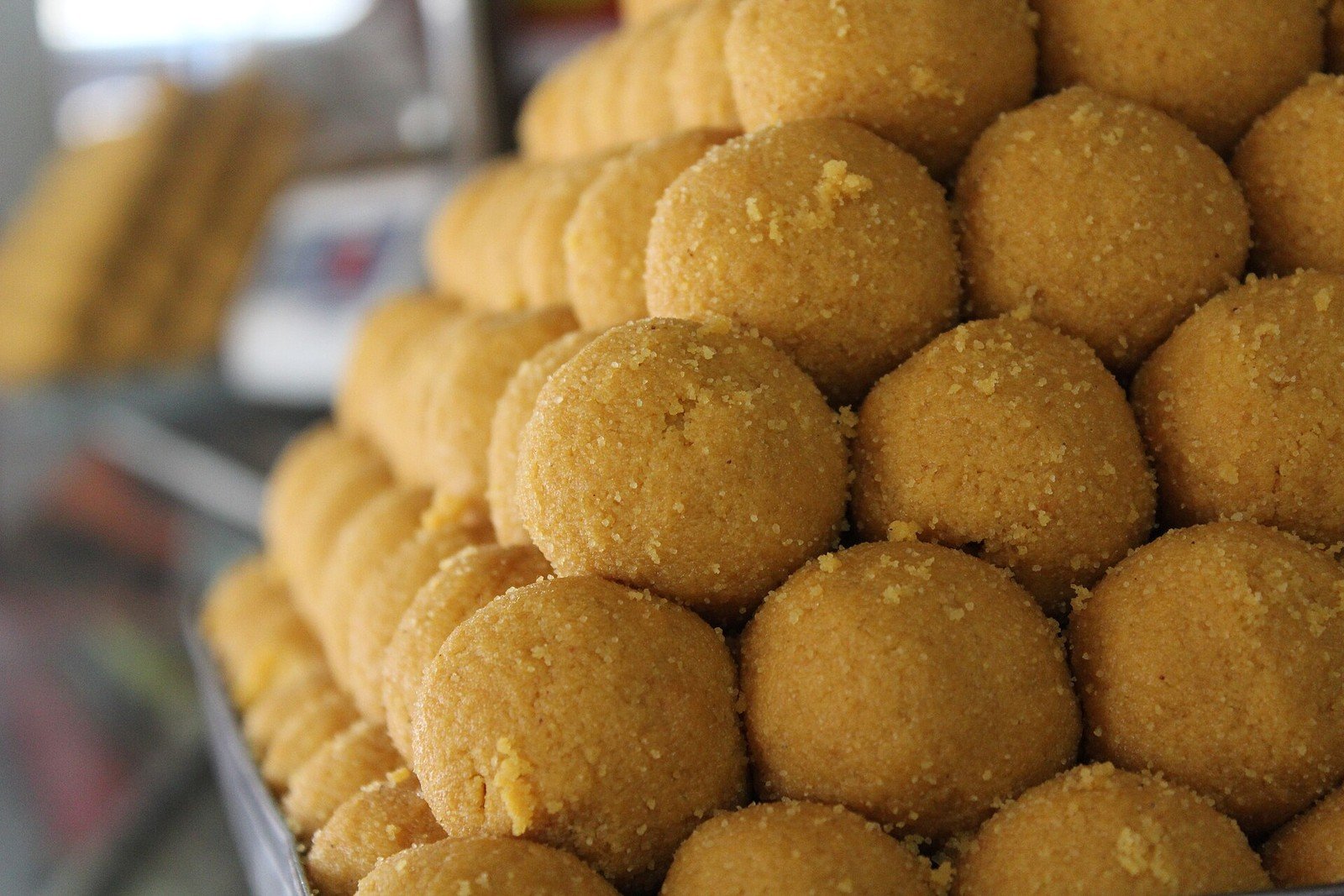
Besan ladoo is the sweet that survives every festival season on sheer usefulness — it keeps for weeks, travels well in a box, and asks for nothing more exotic than gram flour, ghee and sugar. But its simplicity is deceptive. Everything depends on the roasting: besan cooked too briefly tastes raw and pasty, besan caught a minute too late turns bitter, and somewhere between the two lies the narrow window where the flour turns the colour of old gold and the whole kitchen fills with a deep, nutty smell. The other secret is patience at the end — the mixture must cool to just warm before the sugar goes in, or the sugar melts and the ladoos never set. Get those two things right and you have ladoos that are crumbly, fragrant and properly rich, the way they are meant to be.
Ingredients
Method
- Keep everything measured and ready before the pan goes on — once the besan starts roasting, it needs your full attention and both hands. Sieve the gram flour if it is lumpy, and have the melted ghee warm beside the stove.
- Heat a heavy, wide kadai or pan on low heat. Add the besan and dry-roast it, stirring continuously and scraping the base, for 5 to 6 minutes. At this stage it simply warms through and loses its raw edge; do not expect colour yet.
- Pour in the melted ghee and mix it through the flour. Continue roasting on low heat, stirring without stopping in a steady figure-of-eight, for 22 to 28 minutes. The mixture will pass through stages: first dry and sandy, then clumping, then loose and flowing like wet sand as the ghee releases, and finally fragrant and deep golden. It is ready when the colour is a rich golden brown, it pours almost like thick batter, and the nutty aroma is unmistakable. This is the step the whole recipe stands on — under-roasted besan will taste raw in the finished ladoos no matter what you do later.
- If using melon seeds, stir them in for the last 2 minutes of roasting so they toast lightly in the hot mixture.
- Take the pan off the heat and tip the mixture into a wide plate or thali, spreading it out to help it cool. Leave it for 25 to 30 minutes, stirring once or twice, until it is just warm to the touch — you should be able to hold your palm against it comfortably. The mixture must not be hot when the sugar goes in.
- Add the powdered sugar and cardamom powder (and the chopped nuts, if using) and mix thoroughly with your hands or a spoon until the sugar is evenly worked through. The mixture should hold together when squeezed in your fist. If it feels too dry to bind, work in a teaspoon of warm melted ghee; if too soft, rest it 10 minutes longer.
- Grease your palms lightly with ghee. Take portions of the mixture and roll them firmly between your palms into smooth, tight balls about the size of a small lime — you should get about 12. Work quickly while the mixture is still slightly warm; it turns crumbly as it cools. Set the ladoos on a plate and leave them for 1 to 2 hours to firm up completely before serving or storing.